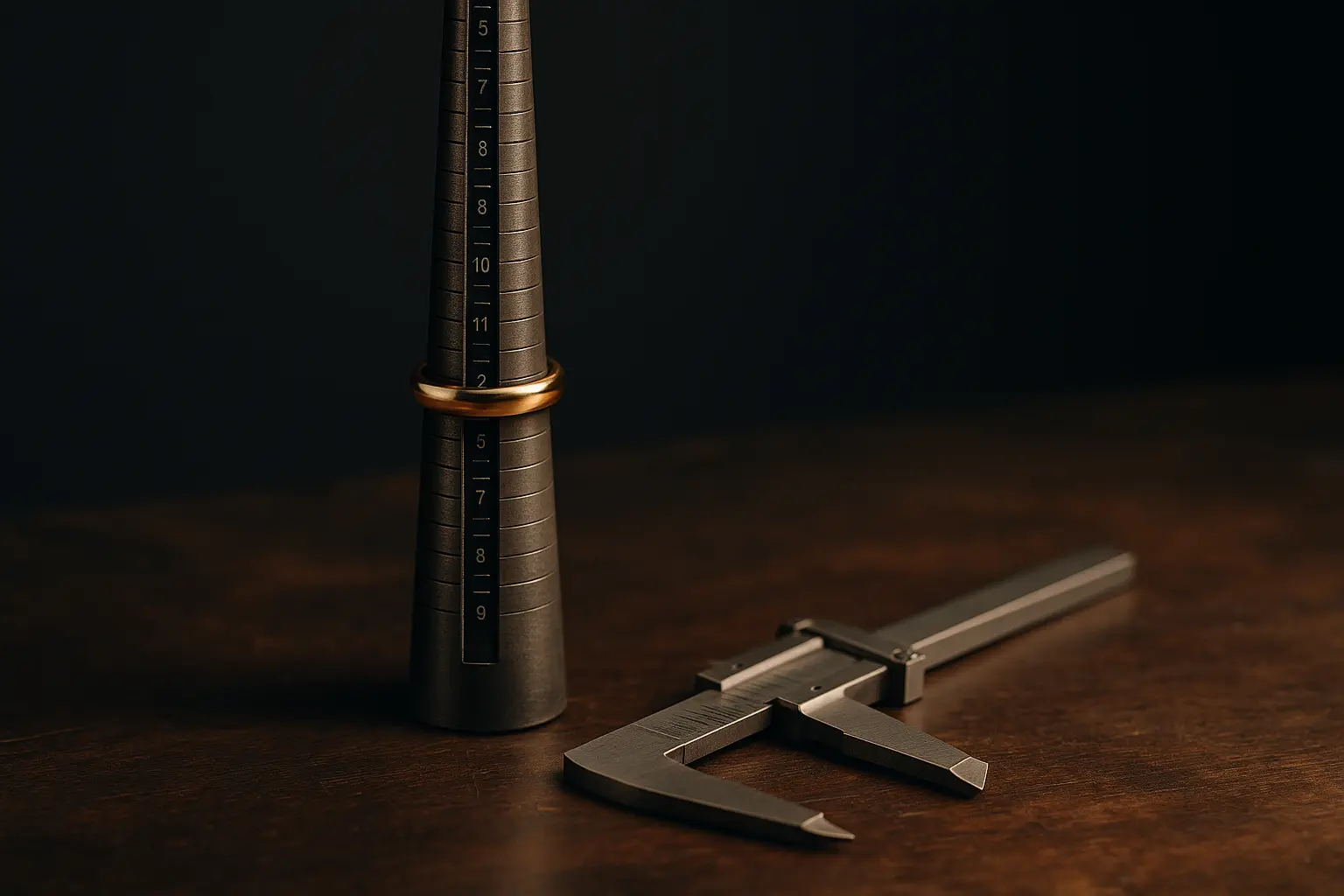
Sizing and fit
Ring sizing and fit: how to get a comfortable, workable measurement
Finger size changes with temperature, time and band width. Learn how professional measurement, knuckle shape, international sizing and future resizing affect a comfortable fit.
Ring size is a range, not a permanent number
Finger size can vary during the day and across seasons. Warmth, humidity, exercise and ordinary fluid shifts can make fingers feel fuller; cold can make them feel smaller. The same finger may also measure differently on the dominant and non-dominant hands. A measurement is therefore a useful starting point, not a permanent body fact. If you are buying a ring for yourself, have the intended finger measured more than once under comfortable conditions. Avoid sizing immediately after strenuous exercise, when your hands are unusually cold, or when you feel swollen. If swelling is persistent or medically unusual, seek appropriate health advice rather than trying to solve it by ordering a different size.
Aim for a ring that passes the knuckle with gentle resistance and then rests comfortably at the base. It should not feel painful, restrict circulation or slide off easily when your hand moves normally. The ideal feel depends on ring width, inner shape and personal preference. Ask the jeweller to explain the fit in terms of your exact design, not only a number on a chart. A ring that is easy to put on but spins constantly may be too loose; one that must be forced over the knuckle may be too tight. Try removing it as well as putting it on, and consider how the fit feels after several minutes rather than deciding from a single quick test.
“Measure correct hand/finger more than once; try width/profile comparable to final ring.”
From the practical checklist

Band width, profile and knuckle shape matter
A wide band contacts more of the finger than a narrow band, so it may feel snugger at the same nominal size. The inner profile also affects comfort: a comfort-fit interior is rounded, while a flatter interior contacts the finger differently. These design features can make two rings marked with the same size feel unlike each other. Whenever possible, try a ring close to the width and shape you plan to buy. If you are ordering remotely, ask whether the maker recommends a size adjustment for the actual design and whether that advice is included in writing. Do not automatically add a half size based on a generic internet rule; finger shape and ring construction change the answer.
A prominent knuckle creates a different fit problem. If the knuckle is substantially larger than the finger base, a ring sized to pass the knuckle may rotate or feel loose once it reaches the base. A jeweller can discuss practical options: adjusting the size, changing the band profile, using sizing beads or a spring insert, or selecting a hinged design where appropriate. Each solution has trade-offs in comfort, appearance, cost and service. Ask to see or feel the proposed option before approving it. Do not rely on a removable plastic sizer as the final fit test for a valuable ring; it may help temporarily, but the jeweller should assess the real metal ring and its intended wear.
Get measured professionally and verify the sizing system
A professional measurement is usually more reliable than wrapping a strip of paper around a finger, but a measurement tool still needs to match the ring style and sizing system. Ask the jeweller to identify the system used—Hong Kong, US, UK, European or another scale—and record it on the order. Numbers are not interchangeable across charts. If the ring will be made overseas or by a different workshop, confirm the conversion with the maker rather than copying a number from an unfamiliar chart. When possible, try a known ring that fits the same finger and have the jeweller measure its inside diameter, while remembering that a different band width may change comfort.
Home measurement can be a rough screening tool, not a guarantee. A paper strip may stretch, overlap or compress the skin; a string can tighten as it is pulled; a printed chart can be inaccurate if the page was scaled during printing. If you use a guide, follow its instructions, verify print scale and repeat the measurement. Do not measure over a bandage or swollen joint. If you are buying a surprise ring, an existing ring is useful only if it belongs to the correct finger and hand and has a similar profile. Borrowing a ring from a different finger or using a remembered size can create avoidable error. Ask the jeweller what exchange or resizing terms apply before ordering.
Plan a surprise without guessing blindly
For a proposal or gift, consider asking a trusted friend to help obtain a measurement or borrow a ring discreetly. Confirm the exact finger and hand; the same person can have different sizes across fingers. If you borrow a ring, photograph its orientation and return it promptly, and tell the jeweller whether it is a narrow or wide band. The inner diameter can be measured, but the recipient's preferred fit and the final design still matter. A store's display ring or another family member's ring is not a reliable substitute. If secrecy is important, ask the seller about a temporary sizing appointment after the gift, exchange window or temporary adjuster, and obtain the conditions in writing.
A surprise purchase has extra policy risk. Custom, engraved or altered items may be treated differently from standard stock under a retailer's return or exchange terms. Before paying, ask how long a size adjustment can be requested, whether it is complimentary, who pays shipping, which designs cannot be resized and whether changing size affects any warranty. Do not assume a complimentary first resize applies to every metal, setting or ring. If the retailer cannot guarantee a fit before the recipient tries it, budget for a possible adjustment and make the proposal plan independent of an exact same-day fit. The seller should explain the available options without suggesting that every ring can be resized indefinitely.
Sizing before a custom ring is made
For a custom ring, size should be confirmed at the stage the maker specifies, using the actual design or a suitable model. Ask whether the measurement will be taken with a sizing band that matches the intended width, whether the model reflects the final interior profile and what production tolerances apply. A drawing or computer rendering cannot establish fit by itself. If the design includes stones around the entire band, a complex pattern or a material difficult to resize, a later adjustment may be limited. Ask the maker to state those constraints before you approve the design. Keep the approved size, sizing system, band width and date with the order documents.
If your weight, medication or other circumstances can cause ongoing changes in fit, discuss that with the jeweller before committing to a design that has few resizing options. This is not a medical assessment; the practical question is whether the proposed ring can accommodate expected fluctuation or later alteration. Some designs may support sizing beads or a different shank, while others may not. Ask how each option affects appearance, comfort and price. The jeweller should not promise a future adjustment without checking the design and metal. A clear written note about resizing limits is more useful than a vague assurance that "we can always make it bigger."
Resizing is a repair, not a universal button
Many rings can be resized, but the safe range depends on metal, construction, setting, stones, engraving and how much the size must change. A plain band may be simpler than a ring with stones around its full circumference. Some materials or designs may require a new shank, a specialist process or no practical adjustment. Ask the jeweller to examine the actual piece and quote the method, cost and expected turnaround. If the ring has channel or pavé settings, ask whether stones will be checked or reset afterwards. The decision should account for the finished appearance as well as the number on the sizing mandrel.
Before handing over the ring, document its condition with photographs and ask for a receipt describing the piece, requested size and any existing wear. Confirm whether the centre stone or other components need to be removed, who handles them, and whether the work affects a warranty. Ask the jeweller to call before proceeding if inspection reveals additional work. On collection, check the fit and inspect the repaired area under ordinary light. If the ring feels wrong, explain exactly where and when—at the knuckle, at the base, in warm conditions or during removal—and ask what options remain. Keep the service record and any updated documentation with the original purchase papers.
Check fit during ordinary movement
A ring that feels fine while your hand is still may shift during daily movement. Try making a fist, opening your hand, typing and moving the finger naturally. Notice whether the ring pinches, spins, catches neighbouring fingers or slips toward the knuckle. A ring with a heavy top may rotate even if the size is reasonable; sizing beads or a different design could help, but ask a jeweller to evaluate the cause rather than automatically choosing a smaller size. The band should feel secure without requiring force to remove. If your hands change substantially with heat or activity, consider fit across a range of ordinary conditions rather than sizing to an extreme moment.
Remove jewellery for activities that can strike or catch it, and ask the maker whether a particular setting is appropriate for your routine. A ring size cannot prevent damage from impact, and a tight ring can become uncomfortable if a finger swells. If a ring becomes difficult to remove, do not keep twisting or pulling until the skin is injured; seek suitable assistance. For a new ring, report persistent discomfort promptly while the retailer's adjustment terms are active. Record the circumstances rather than merely saying "it feels small"—specific details help the jeweller distinguish width, profile, knuckle clearance and overall size.
Before you approve the order
Before paying, write down the intended finger, hand, sizing system, measured size, date, ring width and profile, and any known resizing limit. Ask for the return or exchange window, included adjustment service, costs and delivery arrangements. For a bespoke piece, make sure the approved specification includes the size and the stage at which it becomes final. If you are buying a gift, know how the recipient can obtain a fit adjustment without losing the option to discuss a defect or mismatch. These details do not guarantee a perfect fit on the first try, but they make the next step predictable if the ring needs attention.
Keep the invoice, size record, design approval and any resize receipt. Finger size can change over a lifetime, so a size that fits today may not fit in every future circumstance. Re-measure when needed and have the jeweller assess the actual ring before altering it. A comfortable fit comes from matching a measurement to a person, a design and a sizing system—not from finding a number that works forever. Take time to test the ring, ask direct questions and keep the written terms. If the retailer cannot explain how size was measured or whether the design is adjustable, pause before approving a custom order.
Practical checklist
- ✓ Measure correct hand/finger more than once; try width/profile comparable to final ring.
- ✓ Verify sizing system and record on order.
- ✓ Confirm surprise exchange/resizing terms.
- ✓ Ask custom design limits.
- ✓ Get written resize quote/process.
- ✓ Keep fit and service records.
Published 28 September 2026 · Reviewed 28 September 2026 · Editorial policy · Suggest a correction
Sources and further reading
-
GIA Jewelry Care and Repair
GIA · Accessed 28 September 2026
-
Hong Kong Consumer Council consumer rights
Hong Kong Consumer Council · Accessed 28 September 2026
-
Hong Kong Consumer Council jewellery complaints
Hong Kong Consumer Council · Accessed 28 September 2026