Commissioning a piece
From first sketch to finished piece: how bespoke jewellery commissions work
A stage-by-stage guide to commissioning a piece, clarifying design decisions, costs, approvals, timing, documentation and aftercare before you pay a deposit.
Decide whether bespoke is the right route
Bespoke jewellery can mean several different things. One retailer may use the word for a piece selected from a catalogue with a choice of metal or stone; another may mean a design developed specifically for one client from a blank page. Between those extremes are semi-custom options: a standard setting with a different centre stone, an adjusted band, a change to proportions, or a choice among a small family of designs. Before comparing studios, ask what "bespoke" includes in this particular offer. Which elements can change? Which are fixed by the maker's process? Is the design exclusive, or can the studio make the same form again? The answers affect price, production time, approval points and what happens if you later want a revision.
Start with the problem the piece should solve. It may be a ring for daily wear, a pendant using an heirloom stone, a pair of earrings that match an existing piece, or a gift for a particular occasion. Collect a few references, but explain what you like about each—profile, colour, texture or proportion—rather than asking the jeweller to copy a protected design. Mention practical constraints such as allergies, hand use, preferred weight, budget and deadline. You do not need to arrive with a finished drawing. A useful first consultation translates your preferences into feasible options and points out trade-offs. If the studio immediately promises every feature at any budget without asking questions, ask for a more specific design brief before proceeding.
“Define what "bespoke" includes; document brief/materials/stone”
From the practical checklist

Choose the maker and agree on the brief
Look at completed work that resembles the kind of object you want, not merely the studio's most dramatic photograph. Examine finishing, symmetry, setting details and how the piece looks from the side. Ask who will do the design, setting, casting, stone sourcing and final quality checks; some studios perform every stage in-house, while others work with specialist partners. Neither arrangement is automatically better, but you should understand who is responsible and who to contact if an issue appears. Request a written brief recording the type of piece, approximate dimensions, materials, stone requirements, target price range and desired delivery date. For heirloom stones, establish who holds the stone, how it will be insured while in the studio's care, and how it will be returned if you stop the project.
Discuss communication before a deposit. Who is your contact? How many design options or revision rounds are included? What is the expected response time? Will decisions be recorded by email or in a signed approval document? The value of a written brief is not bureaucracy; it prevents two people from remembering a different conversation months later. Ask the studio to flag assumptions, such as stone size, metal weight, finish, engraving or whether the quoted price includes a matching chain. A clear brief also makes it easier to compare studios. If your budget is a ceiling, say so. The jeweller can then propose a design that fits it rather than showing a more elaborate idea and asking you to remove details one by one.
Understand stone selection and material claims
If the commission includes a gemstone, identify the exact stone or define the acceptable range. A brief might specify a natural or laboratory-grown diamond, a particular gem species, shape, approximate size, colour range and whether a grading or identification report is required. Coloured stones vary naturally, so a reference image cannot guarantee a match. Ask whether the studio is sourcing the actual stone for your approval or working from a sample. Clarify whether the price covers one stone or permits a substitute if it becomes unavailable. If a stone has undergone treatment or is laboratory-grown, request a clear written disclosure. For diamonds, ask whether the report describes the specific stone and who will match its report number or inscription to it before setting.
Agree what evidence will accompany the finished piece. A grading report describes certain characteristics under a laboratory's system; it is not a monetary valuation, a guarantee of future value or a warranty on the setting. A sales invoice records the materials and transaction. An appraisal is a separate professional estimate for a stated purpose and date. Ask which documents the studio supplies and whether any laboratory fee is additional. For heirloom stones, arrange a condition record before the work begins, including photographs and any visible chips or wear. That record is useful for both parties. If you care about geographic origin or responsible sourcing, ask what evidence the studio can provide; avoid treating a broad ethical label as proof unless it is supported by a specific standard or documentation.
Make the quotation genuinely comparable
A written quotation should describe the proposed piece and the costs included. Ask for metal type and fineness, approximate weight if available, stone details, setting work, design fee, engraving, finishing and any external laboratory or shipping charges. Find out whether the quoted total is fixed or an estimate that can change if metal prices, stone availability or the design changes. If a range is given, ask what conditions lead to the lower or higher figure. Do not compare two totals unless the design, materials, stone quality, service and taxes or fees are aligned. A lower estimate may exclude a stone, a design revision or a final valuation; that does not automatically make it poor value, but you should know what is missing before you commit.
Read the deposit, cancellation and refund terms. How much is due initially? What work does it pay for? If you pause or cancel after the sketch, stone purchase or casting, which amounts are refundable and which costs have already been incurred? Is the design fee separate from the materials? What happens if the selected stone is unavailable? Ask how additional work is approved and priced: the studio should not rely on an open-ended verbal authorization for a substantial cost increase. Put key commitments in the quote or contract, including the final design, price basis, payment milestones and what counts as a client-requested change. Policies vary from studio to studio, so do not assume another jeweller's terms apply.
Treat approvals as real decision points
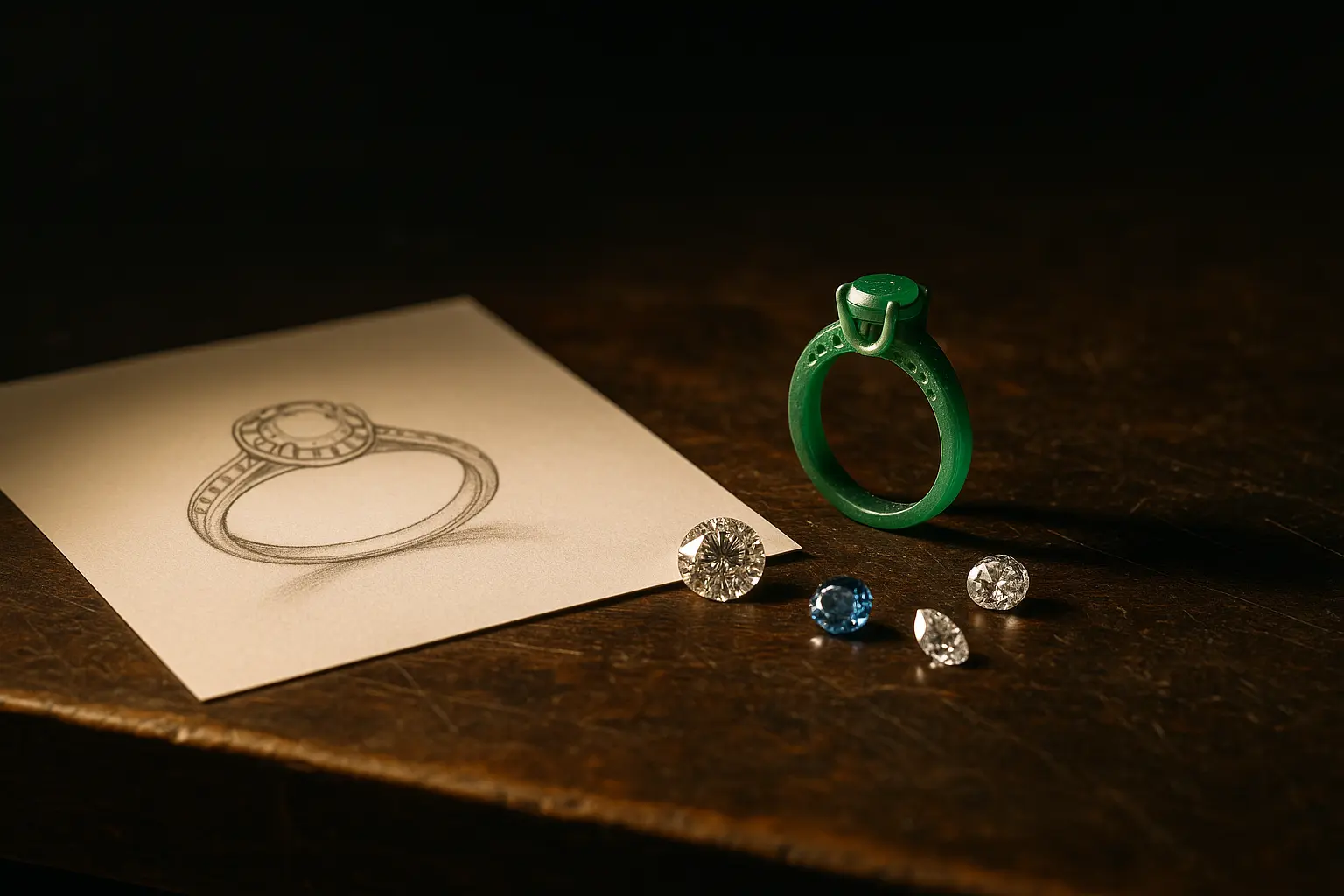
A typical commission may move through consultation, sketch or computer-aided design (CAD), a physical model, stone approval, production and final inspection. Not every studio uses every stage. Ask what representation you will see before metal is committed. A drawing helps with silhouette and proportions but cannot show every detail of weight or how a stone looks in person. A CAD render is a useful three-dimensional proposal, yet lighting and scale can be misleading on a screen. A wax or printed model may help you assess volume and fit, but its surface and colour are not the finished metal. Ask which stage requires your written approval and what changes are still possible afterwards.
Read the approval carefully. Confirm dimensions, stone orientation, setting height, band width, engraving, finish and any visible details. If you approve a model, keep the approved file, photographs or signed drawing with the project records. Ask what happens if the finished piece differs materially from the approved design, and whether a correction is included or quoted separately. A design approval should not be treated as a waiver of every later concern; it records the state of the proposal at that stage. Conversely, changing a detail after final approval can require new labour or materials. Clear approval points protect both the maker and client by tying decisions to a specific version rather than an evolving verbal description.
Set a realistic schedule and plan for uncertainty
A bespoke timeline depends on design complexity, stone sourcing, outside specialists, the studio's workload and the number of approvals. Ask for a written schedule with estimated dates for consultation, design review, stone selection, production and collection. Confirm when the clock starts: often it is after the final brief, deposit or stone approval, but the studio's process determines this. Ask what could change the schedule, and how you will be informed if a supplier delay or revision affects delivery. A date described as an estimate is not the same as a guaranteed deadline. If the piece is for a wedding or proposal, allow time for fitting and possible correction rather than planning collection on the last available day.
Keep decisions moving without rushing them. Agree how long you have to review a drawing or model and what happens if you need more time. If the date is important, ask whether the studio can realistically accept the work before paying. Avoid a vague promise that the piece will be "ready soon"; request a dated estimate and the next update point. If a delay occurs, ask whether the studio can offer an interim update, revised date or alternative plan, and record the agreement. A careful process makes uncertainty visible early. It cannot remove every production risk, but it gives you time to decide whether the project still meets your needs.
Inspect the finished piece and keep its records
At collection, compare the piece with the approved design and invoice. Check the metal description, stone identity and orientation, dimensions, finish, clasp or closure, engraving and any included report. Try it on if fit is relevant. Ask the maker to demonstrate how a clasp works and how the piece should be put on or removed. Inspect under ordinary lighting as well as the store's display lights. If something seems different, raise it before leaving and ask the studio to record the concern and proposed next step. Do not rely on a verbal promise to fix an issue later; request a written service note with a date and expected completion.
Keep the contract or quotation, design approvals, stone documents, invoice, report, photographs and aftercare instructions together. Ask who owns the design files and whether the studio may photograph or publish the finished piece; get permission terms in writing if privacy or exclusivity matters. The studio may retain technical files, while you may receive a rendering or final product photograph; these are separate questions. If you want to use your own stone again or have another jeweller service the item, ask what information is needed. An accurate file saves time for future repair, resizing or insurance discussions.
Ask about care, repairs and design rights before you begin
Ask what routine inspection or cleaning the studio recommends for this exact design. Prong settings, delicate chains, pavé details and softer gemstones can have different care needs. Find out whether cleaning or inspection is included, for how long, and whether it is a written service or discretionary goodwill. Confirm whether third-party repair changes any warranty or service terms. Ask about resizing limits before production, since changing a finished design can affect stone placement or proportions. These are not reasons to avoid a complex piece; they are practical details that help you understand the life of the object after collection.
Finally, decide what "custom" means to you beyond appearance. Do you expect the design to be unique? Can the maker reuse the underlying design for another client? May the studio show the piece publicly? Are sketches, CAD files or photographs provided to you? There is no single arrangement that applies to every commission; agree on it before design work begins. A good commission combines creativity with clear decisions: a brief you can explain, a maker whose work you trust, a price and schedule you understand, approval points you can review, and written terms for changes and aftercare. If any essential promise remains vague, ask for clarification before paying the deposit.
Practical checklist
- ✓ Define what "bespoke" includes; document brief/materials/stone
- ✓ Clarify who performs each stage
- ✓ Itemise price and deposit/cancellation terms
- ✓ Set written approval points
- ✓ Obtain a dated schedule
- ✓ Inspect finished work against approval
- ✓ Keep drawings/reports/invoice and written aftercare/design rights
Published 28 September 2026 · Reviewed 28 September 2026 · Editorial policy · Suggest a correction
Sources and further reading
-
GIA 4Cs
GIA 4Cs · Accessed 28 September 2026
-
GIA Report Check
GIA Report Check · Accessed 28 September 2026
-
Hong Kong Consumer Council Consumer Rights
Hong Kong Consumer Council Consumer Rights · Accessed 28 September 2026