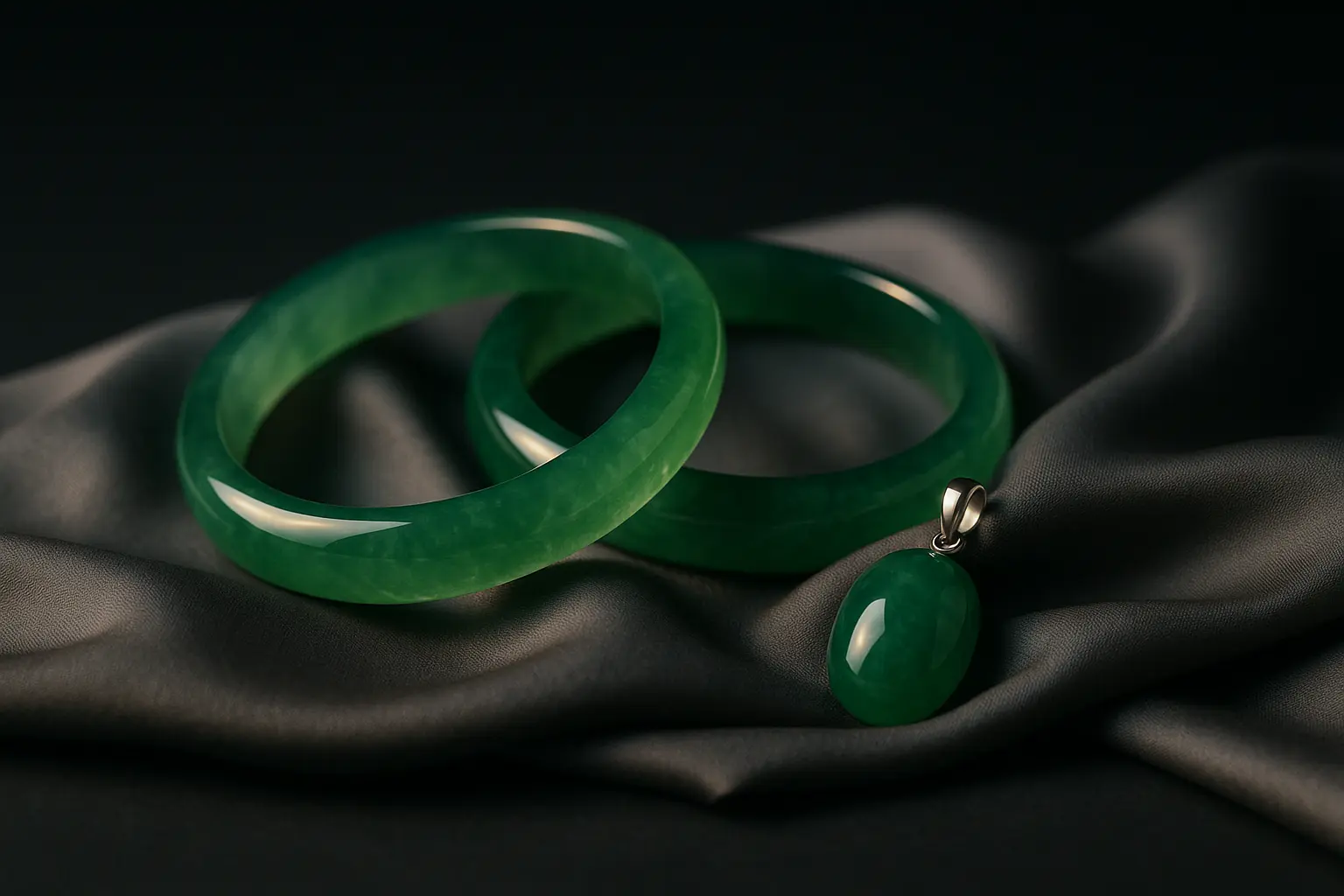
Jade
Buying jade in Hong Kong: jadeite, treatment disclosure and careful comparison
A measured guide to jadeite and nephrite, common treatment vocabulary, judging a piece in person, understanding reports and asking for written descriptions before purchase.
Start by identifying what "jade" means
"Jade" names two different gem materials: jadeite and nephrite. Both have long cultural histories and can be fashioned into jewellery, carvings and objects, but they are distinct minerals with different appearance and gemological properties. A description that says only "jade" does not tell you which material you are considering. Ask the seller to identify jadeite or nephrite in writing, and ask what evidence supports the identification if the distinction affects your decision. The Gemological Institute of America's [jade buying guide](https://www.gia.edu/jade/buyers-guide) explains the difference and the factors used to evaluate jade. The word "jade" alone is not a quality grade, a treatment statement or proof of origin. Begin by clarifying the material before comparing colour, translucency or price.
Jadeite is often the focus of discussions about fine green jade, but it occurs in a range of colours and qualities; nephrite also has varied colours and forms. Neither is automatically more suitable for every buyer. A small jadeite pendant may be right for one design, while a nephrite bangle may appeal for another. Do not assume a vivid green appearance means a particular grade or that a pale piece is necessarily inferior. Ask what the seller's description means for that exact item: material, natural or treated status, any dye or polymer impregnation, dimensions, setting and documentation. If the seller uses a named category or commercial term, ask for the definition and whether it appears on an independent report. Specific questions are more reliable than relying on a familiar word.
“Clarify whether the material is jadeite or nephrite.”
From the practical checklist

Understand treatment vocabulary without treating it as a statutory grade
In the gem trade, "A jade" is commonly used for jadeite that has not undergone certain treatments beyond cutting and polishing; "B jade" commonly refers to jadeite that has been bleached and polymer impregnated; and "C jade" commonly refers to dyed jadeite. Combined treatments may also be described. These labels are trade shorthand, not a complete laboratory report and not a universal legal grading scale. GIA's [jade treatment overview](https://www.gia.edu/gem-treatment) describes treatments used for gems, while its [jade buyer guidance](https://www.gia.edu/jade/buyers-guide) explains why treatment can affect value and durability. Ask the seller to state the treatment claim precisely rather than relying only on an A/B/C label. If a report says "no indications of treatment" or uses other wording, read the report's scope and the laboratory's limitations.
Treatment can change how a piece looks and how it should be cared for. Bleaching and impregnation may affect structure; dye may change or concentrate colour. The effect varies by material and process. A treatment disclosure is not by itself a judgment of whether you should buy the piece. It gives you information for comparing it with other objects and for understanding care, durability and price. A seller may not know every historic step taken before the piece reached them, so ask what they know and whether an independent laboratory has examined it. If the answer is uncertain, the invoice should not state a stronger claim than the seller can support. Avoid treating "untreated" as proven merely because it is not mentioned in a listing.
Look at colour, translucency, texture and polish together
Colour attracts attention, but jade should be examined as a whole. Observe the colour in diffuse daylight or neutral white light, then compare it under the shop lighting. Warm lamps, coloured display surfaces and camera processing can shift green, lavender, white and other hues. Look for evenness, patches, veins and transitions. Natural-looking variation is not necessarily a defect, and uniform colour is not proof of dye; the right question is what the seller claims and what evidence supports that claim. Translucency describes how light passes through the material and can vary across a single piece. Texture, polish, surface finish and carving quality also influence appearance. Examine the piece from several angles and at normal viewing distance before using magnification.
Compare similar forms. A bangle should be viewed around its full circumference, not only at the best-looking front. A cabochon or pendant should be turned to inspect edges, thickness, polish and any visible fractures or surface irregularities. Ask whether an observed line is a natural feature, a fracture, a seam or part of the carving; do not assume from a photograph. If the piece is set, ask what is hidden by the mounting and whether the seller can show a comparable unmounted view. The word "translucent" is descriptive, not a report grade by itself. The proportions and colour that look balanced to you matter. If you are choosing a culturally significant piece, decide what style and form are personally meaningful rather than letting scarcity claims dictate the choice.
Why photographs and short videos are not enough
Jade's colour and translucency can be especially difficult to judge online. Automatic white balance, exposure, screen brightness, compression and background colour all affect the image. A seller may photograph a piece against a dark surface to emphasise translucency, while a pale background makes another colour appear stronger. Neither photograph necessarily represents the appearance in ordinary indoor light. Ask for an unfiltered video of the actual piece rotating slowly under neutral light, exact dimensions, and a clear return policy before paying. Confirm whether the images show the item for sale or a representative sample. A video can add context but still cannot replace an in-person view or independent examination for a high-value purchase.
When visiting a shop, step away from display lights and view the piece near a window or under neutral lighting if possible. Ask to compare it against a white card and a darker background, and see whether you still like the colour. If the seller declines, that is not proof of wrongdoing, but it is a reason to rely less on a visual claim that you cannot check. Keep screenshots or a dated copy of the online listing and written descriptions. If the delivered piece differs materially from the photographs or stated attributes, those records help you explain the discrepancy to the seller or a consumer-advice service. Do not allow a "one day only" claim to replace the time needed to inspect the piece.
What a laboratory report can—and cannot—tell you
A gemological report may identify whether a material is jadeite or nephrite and may comment on detectable treatments, but the exact service and terminology vary by laboratory. Read the issuing laboratory, report number, date, item description, photographs and conclusion. Confirm the report refers to the exact object offered; compare dimensions, shape, identifying features and any inscription or seal. Use the laboratory's own report-check service where available. A report does not automatically provide a retail valuation, establish a mine or geographic origin, guarantee future price, or certify every aspect of craftsmanship. If you need a monetary valuation for insurance, ask an appropriately qualified appraiser and the insurer what format is required. Keep valuation and identification separate in your mind.
Some reports use "A," "B" or "C" terminology, while others describe observations in prose. Ask what the specific wording means. "No indications of treatment" is an analytical conclusion within the laboratory's methods and detection limits, not an absolute promise that no treatment could ever exist. If two reports seem inconsistent, ask each issuing laboratory for clarification rather than choosing the more favourable phrase. For expensive pieces, consider a report from an independent, recognised gemological laboratory before purchase, and confirm in writing who pays for the examination and what happens if the result differs from the listing. This is a reasonable due-diligence step, not an accusation about the seller.
Compare the transaction and get claims in writing
A fair comparison includes the full description and transaction terms, not only colour or headline price. Ask for material, dimensions, weight where relevant, treatment disclosure, metal or setting details, and any report number on the quotation or invoice. Ask whether the item is sold as natural, treated, dyed or otherwise enhanced, and what the retailer's return or exchange policy says if an independent report does not match the description. Policies differ by business and by item. Do not assume a custom, altered or discounted item has the same return terms as a standard piece. Ask about deposits, cancellation, repair and aftercare before paying. A written description is more useful than a verbal promise, especially for a piece whose value depends strongly on material identity and treatment history.
The Hong Kong Consumer Council has reported jewellery-related complaints. Its [jewellery complaint information](https://www.consumer.org.hk/en/press-release/532-jewelry-complaints) is useful context, not a guarantee of a particular outcome in an individual dispute. Keep the dated listing, messages, quotation, invoice, report and photographs together. Check the seller's official contact details and use those channels for clarification. If a claim sounds technical, ask the seller to explain it in plain language and identify supporting evidence. If uncertainty remains, pause or seek independent professional advice. A directory's verification status can confirm limited details such as identity or website control; it does not authenticate a particular jade object or endorse its quality.
Care for the piece according to its material and treatment
Ask the seller how to clean and store the exact item. Jade is often described as tough, but toughness does not make every piece immune to chipping or damage. A bangle can strike a hard surface; a thin carving or setting may have vulnerable edges. Avoid sudden temperature changes and household chemicals unless a qualified professional confirms they are safe for the material and treatment. Do not assume ultrasonic or steam cleaning is suitable, especially if treatment is unknown. GIA's [jade care and cleaning guidance](https://www.gia.edu/jade-care-cleaning) recommends gentle care and explains considerations for jade. Follow advice for any metal, adhesive, dye or setting that is part of the finished jewellery, since the least durable component may determine the safest method.
Store jade separately from harder stones and metal jewellery to reduce scratching and impact. Remove a ring or bangle before activities where it may be knocked, and check settings or clasps periodically. If the piece changes colour, develops a surface issue or suffers an impact, take it to a qualified jeweller or gemmologist for assessment rather than polishing it at home. Keep the report and purchase record available for future service. If a seller offers periodic inspection, confirm scope, fee and schedule in writing; a routine interval is not universal because wear and construction differ. Care advice should be specific to the piece, its treatment and the way you wear it.
A thoughtful buying checklist
Before deciding, write down what you value most: a particular material, colour, shape, translucency, carving, cultural form or budget. Inspect the actual piece under more than one light source. Ask whether it is jadeite or nephrite, whether it has been treated, and what evidence supports the claim. Request an independent report where price or uncertainty justifies one, then match the report to the item. Read the full quotation and return terms before paying. If an answer matters, ask for it in writing. These steps will not remove every uncertainty, and they do not make one style objectively better than another. They make the decision more informed and give you a record of what the seller represented.
Give yourself time. A jade purchase may carry personal, cultural or family meaning that is not captured by a technical description. It is reasonable to ask a relative or trusted adviser to look with you, especially if you are comparing forms or colours you have not bought before. Do not buy because someone says that a particular colour or treatment status is certain to rise in value. Jade markets are diverse and future prices cannot be promised from a label or report. Buy a piece you understand, can care for, and genuinely want to wear or keep. If the seller's explanation remains unclear, walking away is a sound decision—not a missed opportunity.
Practical checklist
- ✓ Clarify whether the material is jadeite or nephrite.
- ✓ Ask what any A/B/C treatment term means and request the specific disclosure in writing.
- ✓ Inspect colour, translucency, surface, polish and construction in neutral light.
- ✓ Match any report to the actual piece and read its scope and limitations.
- ✓ Get treatment, return, deposit and aftercare terms on the quotation or invoice.
- ✓ Keep reports, photos, listing and receipts together; store jade separately and avoid harsh cleaners.
Published 28 September 2026 · Reviewed 28 September 2026 · Editorial policy · Suggest a correction
Sources and further reading
-
GIA Jade Buyer's Guide
GIA · Accessed 28 September 2026
-
GIA Gem Treatment
GIA · Accessed 28 September 2026
-
GIA Jade Care and Cleaning
GIA · Accessed 28 September 2026
-
Hong Kong Consumer Council jewellery complaint information
Hong Kong Consumer Council · Accessed 28 September 2026