Understanding diamond documents
How to read a diamond grading report before you buy
A report is a structured description of a particular diamond—not a valuation, warranty or promise of future value. Here is how to read it and verify the stone it describes.
First ask what document you are holding
“Certificate” is used casually in jewellery retail, but the paper may be a grading report, an appraisal, a sales document or a retailer’s own description. Those documents answer different questions. A grading report records a laboratory’s assessment of characteristics such as weight, colour, clarity, measurements and cut grade, using that laboratory’s procedures and terminology. An appraisal estimates a monetary value for a stated purpose and date. A receipt records the transaction. A warranty describes a seller’s commitment under specified terms. None should be treated as a substitute for the others. Before comparing stones, ask who issued the document, what service was performed, whether it describes the exact loose stone or finished ring, and whether you may read it before making a payment. If the seller uses “certified,” ask what that means in this specific transaction rather than assuming the word identifies a particular independent body.
Reputable gemological laboratories explain their own scope and limitations. The [Gemological Institute of America (GIA)](https://www.gia.edu/gem-lab-service/diamond-grading) describes diamond grading as an independent assessment of quality characteristics, not an appraisal or guarantee of value. Laboratories can use different terminology, scales, equipment and procedures. Two reports should therefore not be treated as perfectly interchangeable just because they list the same headings. A report also cannot tell you whether you personally like a stone’s appearance, how it will look in a particular setting, or whether the retailer’s price and service terms are right for you. Think of it as one useful piece of evidence in a purchase file: precise enough to support questions, but not a verdict that removes your own comparison.
“Identify whether the document is a grading report, appraisal, receipt or warranty.”
From the practical checklist

Match the report to the actual diamond
Start with the report number and the identity details. Compare the report’s measurements, shape, carat weight and plotted clarity characteristics with the diamond being offered. Where the report records a girdle inscription, inspect it with the seller or a qualified professional and confirm the number matches. GIA’s [Report Check](https://www.gia.edu/report-check-landing) lets users verify information for eligible GIA reports. A successful lookup confirms that the report record exists and shows the details held by the laboratory; it does not, by itself, prove the stone in a display case is the stone linked to that record. The final physical match requires checking the stone’s features and any inscription. Ask whether the stone can be examined loose or under magnification before setting, and who will document the match if the report and stone are handled separately.
Check that you have the complete report, not only a cropped photograph or a retailer’s summary. A sales card may omit comments, proportions or identifying notes that affect how you interpret the stone. Make sure the name of the issuing laboratory, report number and date are visible. If the item is already mounted, some details may be harder to inspect, and the report may describe the stone before setting; ask the jeweller to explain what can and cannot be confirmed once mounted. Keep a copy of the report with the final invoice and item description. If a number on the report, inscription or retailer’s paperwork differs, stop and ask for a written explanation before paying. A minor clerical correction may have an innocent explanation, but you should not have to guess which record is authoritative.
Read the 4Cs as separate dimensions
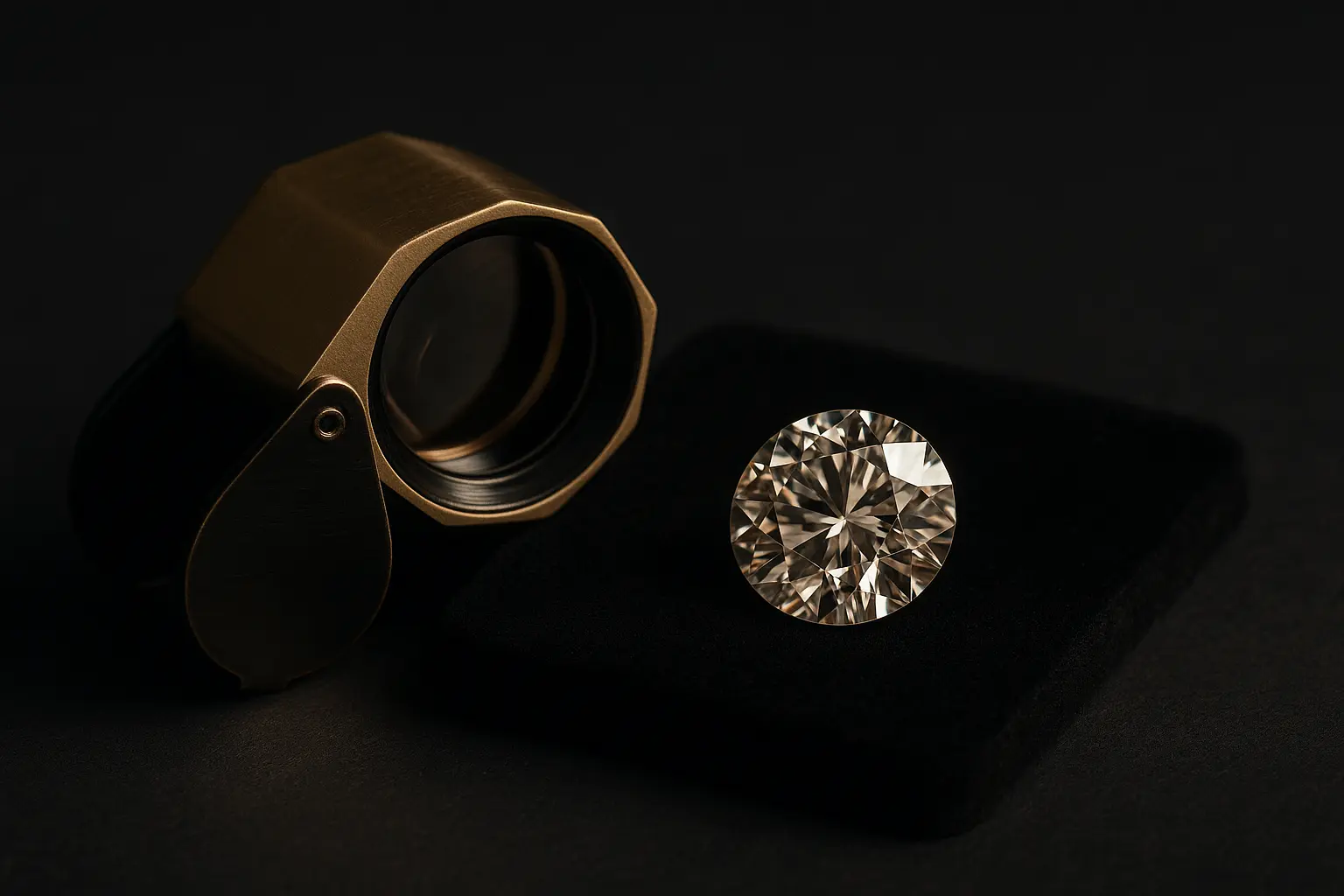
Carat is a measure of weight, not a direct measure of visible size or beauty. Two diamonds of equal carat weight can face up differently because of shape, proportions and depth. Colour grading describes how close a diamond is to colourless within the laboratory’s scale; it does not mean that every buyer will prefer the highest grade. Clarity describes internal and surface characteristics under the stated grading conditions. Some inclusions are difficult to see without magnification, while others influence appearance or durability; the report’s plotted diagram helps locate characteristics but is not necessarily a photograph of how the stone looks to the naked eye. Ask the seller to show the stone at normal viewing distance as well as under a loupe, because a magnified view can make tiny features feel more important than they appear in everyday wear.
Cut is about how a fashioned diamond’s proportions and finish affect its interaction with light; it is not simply the shape name. GIA’s [4Cs guide](https://4cs.gia.edu/en-us/4cs-of-diamond-quality/) explains the factors in its grading system. A report grade can help screen options, but two stones with the same grade can still look different. View candidates side by side, in neutral lighting if possible, and notice brightness, contrast pattern, fire and any areas that appear persistently dark. Fancy shapes such as oval, pear or emerald cut may have different reporting conventions from round brilliant diamonds, so read the actual fields rather than expecting every report to include the same overall cut grade. Choose a report profile that fits your priorities, then let direct viewing matter too.
Understand proportions and plotted features
Many reports include measurements and proportion information. Measurements give length, width and depth; a proportion diagram may show table size, total depth, angles or girdle characteristics depending on the laboratory and report type. These numbers can help a trained professional compare stones, but a shopper should avoid reducing the decision to one ratio. Cut performance involves interacting features, and a number that looks favourable in isolation does not guarantee an attractive appearance. Ask the retailer to explain any proportions they use to support a claim such as “ideal,” and ask which grading standard the word refers to. If a seller promotes a proprietary cut grade, distinguish it from an independent laboratory’s grade and request the criteria in writing.
A clarity plot is a schematic representation of inclusions and blemishes, not a map that predicts exactly what you will see unaided. Symbols indicate types and positions according to the laboratory’s conventions. Orientation, lighting, setting and the observer’s vision change visibility. Ask to see the stone at a normal distance and under magnification, and compare it with another stone at the same distance. If an inclusion is near an edge or surface, ask whether it affects the setting plan or requires extra care; do not assume either that it is dangerous or that it is irrelevant. The grading report is a starting point for a conversation with the jeweller, not a substitute for viewing the actual diamond and asking how the design protects it.
Fluorescence, comments and details buyers overlook
Some diamond reports record fluorescence, a visible response to ultraviolet light. The presence of fluorescence is not automatically a defect or benefit. Its appearance and relevance depend on the particular stone and the way it looks in ordinary environments. Ask to compare the diamond in daylight-like and indoor lighting if the point matters to you. Reports may also include comments, treatments or other identifying information. Read those fields rather than focusing only on the headline grades. If a report contains a comment you do not understand, ask the retailer to explain it and point you to the laboratory’s glossary. Avoid relying on broad claims such as “fluorescence always lowers value” or “a report with no comments means flawless”; both oversimplify an individual stone and market context.
Check whether a report describes natural diamond or laboratory-grown diamond, and whether the origin is plainly disclosed in the retailer’s quotation and invoice. These are both diamond materials, but they are not the same origin category. Reports use their own wording and may identify growth method or treatments where applicable. The U.S. Federal Trade Commission’s [Jewelry Guides](https://www.ftc.gov/business-guidance/resources/jewelry-guides) discuss US advertising disclosures for laboratory-created and imitation gemstones; those rules are specific to US marketing, not a statement of Hong Kong law. For a purchase in Hong Kong, ask the seller to state the origin and any relevant treatment in the written transaction documents. If an important detail is stated only verbally, request it on the quote or invoice before you commit.
A report is not an appraisal or a resale forecast
A grading report describes gemological characteristics; it does not tell you what an insurer will accept, what a future buyer will pay, or what the diamond will be worth later. An appraisal is a separate opinion of value, prepared for a stated purpose such as insurance scheduling or estate documentation. The value basis, date, assumptions and appraiser’s qualifications matter. A retail replacement estimate is not necessarily equivalent to resale value, and neither guarantees a later transaction price. If insurance is important, ask the insurer what document and valuation format it needs before paying someone for a report you may not require. Keep the purchase invoice as evidence of what you paid, but do not assume it performs the function of a current valuation.
Be cautious of language that turns a report grade into a return guarantee. Diamonds are not interchangeable commodities in the way a simple grade label can imply: actual appearance, availability, setting, retailer terms and market conditions all matter. A laboratory report is valuable because it gives you a shared description to compare, not because it predicts that the stone will appreciate. The [GIA consumer guidance](https://www.gia.edu/gia-news-research) distinguishes gemological information from monetary appraisal. If a seller uses a report to claim a guaranteed resale amount, ask who is making that promise, for how long, under what conditions, and where those terms appear in writing. Otherwise treat the report as evidence about the diamond, not a financial instrument.
Questions to ask before you pay
Ask: Is this the original grading report for the exact stone? What is the report number, and can I verify it with the issuing laboratory? Does the stone have an inscription, and can the number be matched? Is it natural or laboratory-grown, and are any treatments disclosed? What do the report’s comments and measurements mean for the way this particular stone looks? Can I view it in ordinary lighting and compare it with another candidate? Is the quoted price for the loose stone, the setting, or the completed ring? Which metal and setting details will appear on the invoice? These are not confrontational questions. A transparent seller should be able to explain what each document establishes and what it does not.
Before leaving, collect the report or a clear copy, itemised invoice, written origin and treatment description, and the store’s return, resizing and aftercare terms. Check the name and contact details of the seller, along with any specific delivery date or deposit conditions. If you cannot reconcile the stone with its report, do not let urgency decide for you; ask for time to verify the match or choose another option. For an especially valuable or technically complex purchase, consider an independent gemmological opinion from a qualified professional who is not financially connected to the sale. The best use of a grading report is practical: it helps you ask sharper questions, compare like with like, and keep an accurate record of what you were shown and what you bought.
Practical checklist
- ✓ Identify whether the document is a grading report, appraisal, receipt or warranty.
- ✓ Match the report number, measurements and any inscription to the exact stone.
- ✓ Read all 4C fields, proportions and comments; view the actual stone in ordinary light.
- ✓ Confirm natural or laboratory-grown origin and treatment disclosures in writing.
- ✓ Ask an insurer what valuation documentation it requires; do not treat the grading report as a valuation.
- ✓ Keep the report, itemised invoice and retailer's terms together.
Published 28 September 2026 · Reviewed 28 September 2026 · Editorial policy · Suggest a correction
Sources and further reading
-
GIA Diamond Grading
GIA · Accessed 28 September 2026
-
GIA 4Cs
GIA 4Cs · Accessed 28 September 2026
-
GIA Report Check
GIA · Accessed 28 September 2026
-
U.S. FTC Jewelry Guides
Federal Trade Commission · Accessed 28 September 2026